What Is Finance?
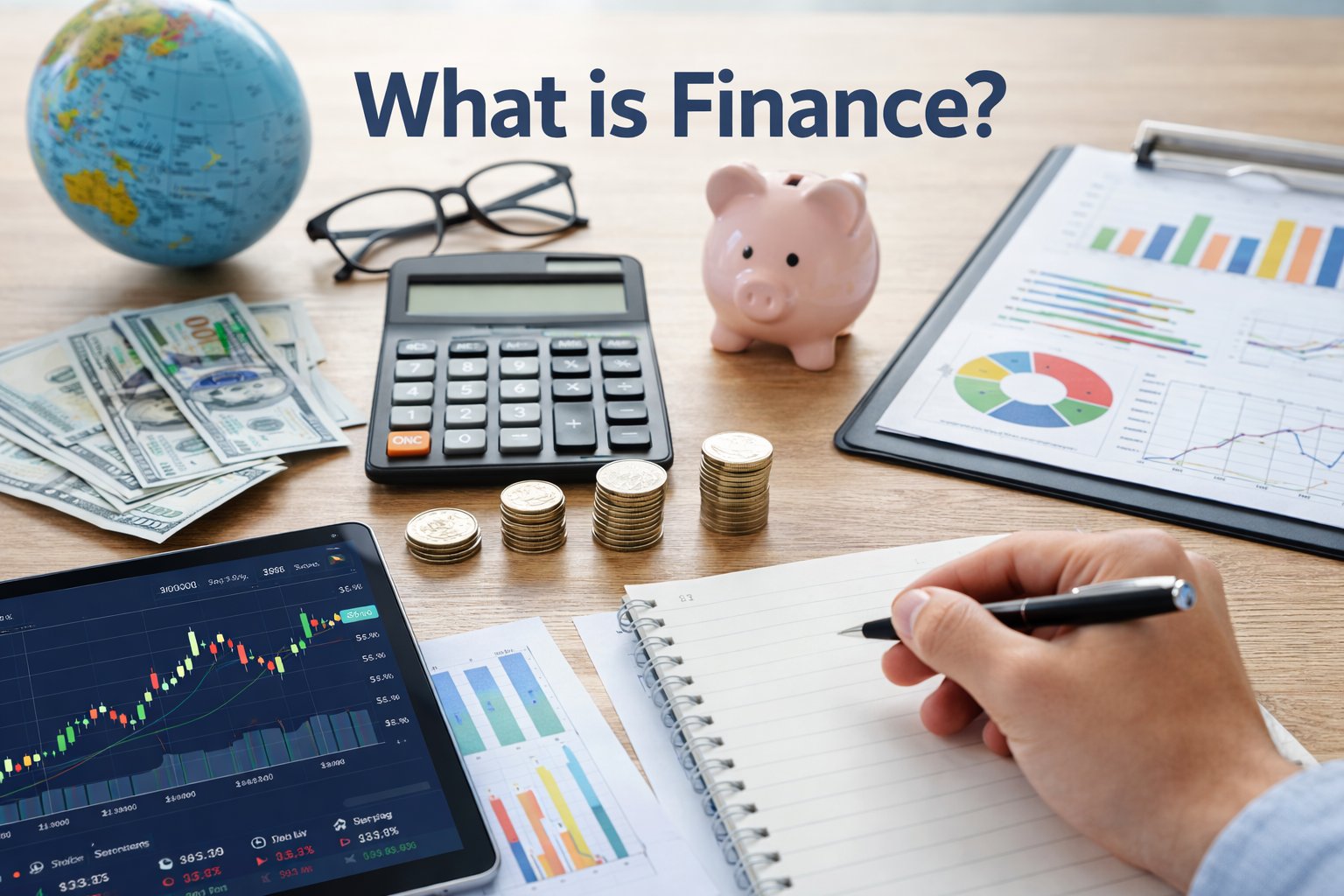
What Is Finance?
If you recall this word finance, think banks, stock markets, well-off people in suits watching their numbers flash on TV screens. Not all of those images come with a false positive, however; they only scratch the surface. it is not just about money it’s about decisions.
Every time you save, spend, invest, borrow, or future plan something, you are talking to money. Whether it is on managing household bills, managing multinational corporation accounts or financing governments, it influences how resources are distributed over time and under uncertainty.
How to do this? In this post, I’ll explain the definition of finance, the various sectors, its impact on everyday life and we are going to argue that knowing it is a key skill that has an immediate impact for everyone.
What is Finance? A Simple Definition. Money, assets, investments, and liabilities is managed over time.
How is money obtained? Is it used? How is financial risk managed? it integrates aspects of economics, mathematics, psychology and strategy to assist customers, corporations and governments in making wise resource judgements.
Why Finance Matters in Life for Everyone You don’t even need to be on Wall Street to be touched by finance. Even a high paying job should be good enough to benefit from this sector. In reality, it is implicated in nearly every real life decision you make.
Real-life Examples of Finance in Action. Creating a monthly budget. Saving for emergencies. Taking out a mortgage. Planning for retirement. Deciding Cash Loan or Credit.
Three Main Forms of Financing. it is generally split into three categories, each fulfilling an objective.
Personal Finance: People and the Individual. Personal finance looks at how customers and families spend their money over time.
Key Areas of Personal Finance. Income and budgeting. Saving and emergency funds. Investing and wealth building. Debt management. Insurance and risk protection. Retirement planning. Personal finance has less to do with how much you make than how you use your money. A huge income without a plan of handling money is normally stress intensive, but a little income plus a clean attitude can create some stability over the long term.
The Financial Technology that Explains Corporate Finance. it relates to how firms raise funds, allocate resources and achieve maximum value.
Corporate Finance Core Goals. Funding operations and growth. Deciding whether or not to invest in new projects. Managing cash flow. Balancing risk and return. Increasing shareholder value. Corporate finance decisions include whether to:
Issue shares or take loans. Expand into new markets. Acquire other companies.
Important Components of Public Finance. Taxation. Public spending. Public debt. Economic stabilization. Public finance impacts:
Education systems. Healthcare. Infrastructure. Social services. National defense. All roads, school and public services are built on the back of a monetary decision taken by the government.
Fundamentals.
To understand it properly, you need to understand some fundamentals.
Time Value of Money. One of the most important financial principles is the idea that money today is worth more than the same amount in the future. Why? Money can be invested. Inflation lowers the purchasing power. The future lies uncertain. This idea describes interest, loans, investment, retirement planning, etc.
Risk and Return. The relationship between risk and return is straightforward:
Lower risk usually means lower potential returns. Higher potential returns usually involve higher risk. Knowing about this relationship allows individuals to do less “dollars-a-day” shopping and more wisely manage all aspects of financial risks.
Liquidity.
Liquidity refers to how readily an asset can be converted into cash without losing value. Cash is the most liquid asset that one can use immediately. Property, however, is much less liquid as you cannot usually sell the asset in time (except when it sells for a specific price). Long-term investments must wait or be penalized for being obtained. In all of this, liquidity is key when being prepared for emergencies or for a short-term financial need.
Finance vs. Economics:
What’s The Difference? Finance and economics are not the same, although they can be misconfused. Economics is the study of the distribution of resources in societies overall. It centers on how societies allocate resources across the board. Finance deals with decision-making with money under uncertainty. Economics is about understanding why markets are that way. Finance concerns itself with how to behave in those markets. They are interrelated but finance is more practical and rule-based.
The Psychology of Finance. Isn’t strictly mathematical. Much of it is human behavior.
Common Behavioral Biases. During market down drops: panic, fear. A bit of overconfidence during market booms. Short-term thinking. Emotional spending.
Develop healthier relationships around money. Good finance is just as much about behavior as it is about statistics.
Finance in the Modern World. Technology has radically altered it.
Digital Trends. Online banking and mobile payments. Global access to markets.
Technology has brought finance up to the masses, but has also magnified the danger of misinformation and bad decisions propelled by hype. The importance of financial literacy has never been more critical.
Why you must be financially literate. So why’s financial information necessary? Many students are learning to spend a number of years in school without gaining:
How to budget. credit works, invest. How to plan for retirement.
The upshot is widespread financial stress, debt and uncertainty. Financial education is about helping people:
Make informed choices. Reduce anxiety around money. Build long-term security. End cycles of financial instability.
Understanding finance is not about how we’ll get rich — it’s about getting beyond the unnecessary struggle and learning how to fight our way around it!
Finance and Long Term Thinking. At its finest, finance fosters long-term thinking. Instead of asking:
“What do I want right now?”
“What will this decision look like in 5, 10 or 30 years?” This mindset, itself, can improve financial outcomes immensely.
Reality: Whether people notice it or not, everybody uses finance today. You Need a Lot of Money to Learn it. Reality: Understanding finance is most important when you’re short on cash. it Is Too Complicated. The truth: The basics are easy. When it’s unnecessary jargon, the complexity may be greater than the number of people.
Knowledge of finance does not guarantee success, but ignorance almost guarantees useless strain in reality. Whether you’re running a home as the head of a family, starting up a business and looking forward in life, it provides better clarity and confidence in where a person should think and what he should do next.
In a time of dollars and clicks, learning what money is actually one of the smartest things you can invest in.
Share this content:













Post Comment
You must be logged in to post a comment.