How Banks Really Work
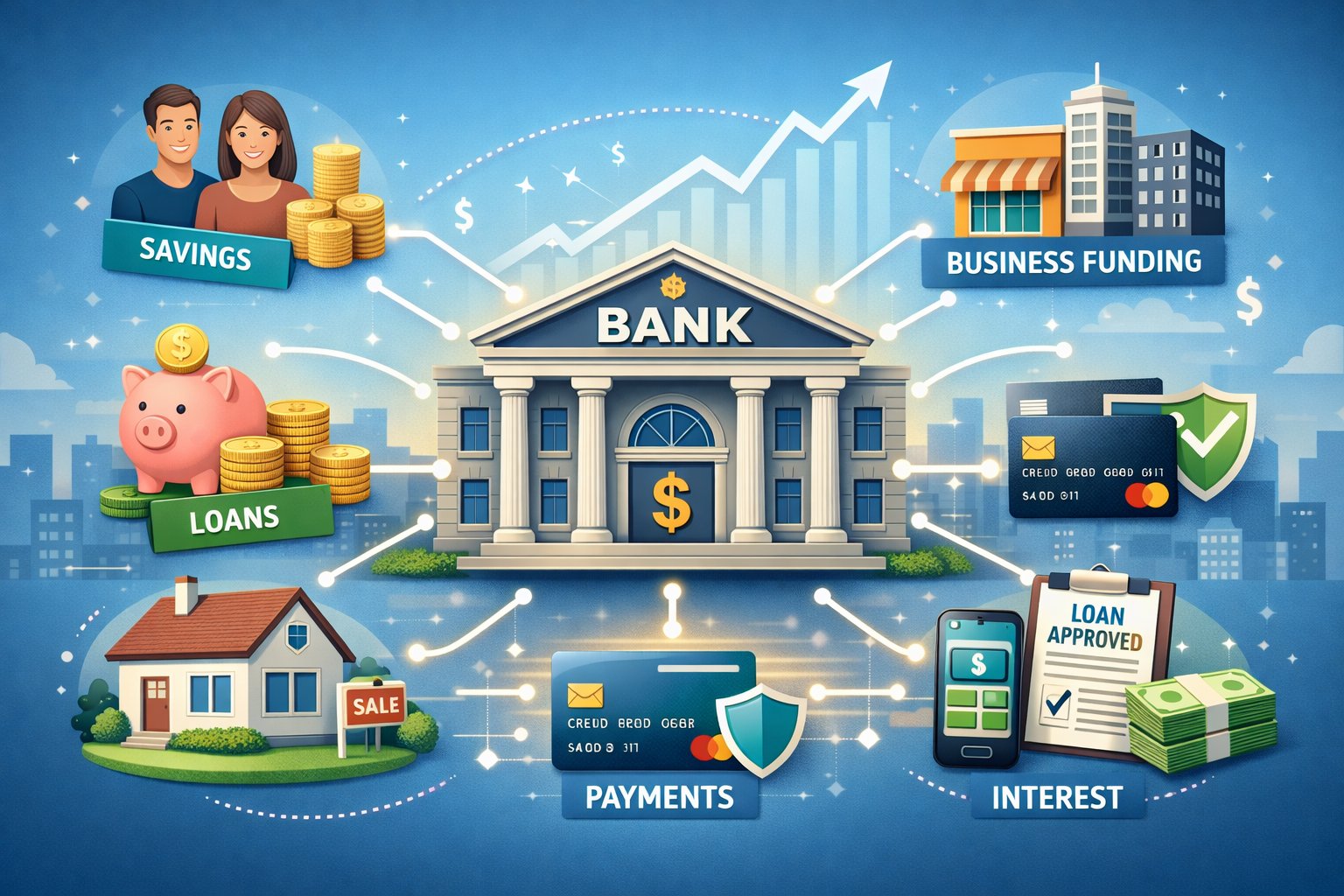
Ever wondered how banks actually work? Let’s take a real look at the system that forms the backbone of our modern economy.
Why Is Understanding Banks Important?
Banks as such are inextricably woven into the fabric of everyday life. Even if you are earning money, saving, covering bills or applying for loans, banks are there quietly supporting nearly every step that you take related to your financial life. But very few people fully understand what a bank is or how banks really operate in the process.
The study of banking does not only serve as an education for economists or business people. It helps people make better financial choices, cut out needless charges, safeguard money from potential fraud and even build wealth over time. In this report, we’ll delve into the basics: what is a bank? How does it work? Why are banks important? What is the difference between a bank and an older entity?
A bank is an institution to provide deposits, security and capital, and services. Banks are essentially intermediaries, or trust middlemen that facilitate the transfer of funds from one person who owns money to another person who needs it.
Banks hold licenses in the hands of governments for safe and sound regulation to make sure the financial system is stable and safe to guarantee that the country remains sound and trustworthy. Without banks, it would be a lot harder to manage money safely and efficiently.
Core Definition
A bank:
Holds money securely.
Allows withdrawals and payments.
Lends money to individuals and businesses.
Facilitates economic growth.
A Brief History of Banking
Banking is not an invention of our time. Early forms of banking can be traced back thousands of years and were found in ancient Mesopotamia: temples and palaces held grain, gold and valuables. Banking spread throughout such early cultures as Ancient Greece, Rome, and medieval Europe. Modern banking emerged during the Renaissance, particularly in Italy, where merchant banks used financial capital to support commerce and exploration.
The global banking system today is so digital and interconnected and regulated — at least at its core, though: safe money management and movement.
How Do Banks Work?
Banks are essentially banks by taking deposits and lending them out. And that simple idea is called financial intermediation.
Step 1: Accepting Deposits
When you deposit your money into a bank account:
The bank maintains some of it as reserves.
The remainder can be lent to other people.
Deposits might contain:
Savings accounts.
Checking/current accounts.
Fixed or term deposits.
Your money isn’t hanging out in a vault but rather helping finance loans and investments.
Step 2: Lending Money
Think about it: banks lend money to people like you and me for things like homes, cars, and personal goals. They also lend to businesses, helping them grow with loans and credit lines.
Governments (through bonds and financing).
The bank charges interest on loans which is greater than that paid by depositors. This disparity serves as one of the biggest ways banks earn money.
Step 3: Earning Profit
Banks earn income through:
Interest on loans.
Account fees.
Credit card charges.
Investment services.
Foreign exchange services.
Of course, banks face their own challenges, like the risk of loans not being paid back or navigating a slowing economy.
Types of Banks
Not all banks are the same. Different banks serve different purposes.
Retail Banks
These are the most regularly used by people amongst banks.
Savings and checking accounts.
Personal loans and mortgages.
Debit and credit cards.
Commercial Banks
Focused on businesses.
Business accounts.
Business loans.
Trade financing.
Investment Banks
Serve corporations and governments.
Mergers and acquisitions.
Stock and bond issuance.
Financial advisory services.
Central Banks
Operate at the national level.
Control money supply.
Set interest rates.
Regulate commercial banks.
You’ve probably heard of some of the big players, like the Federal Reserve in the U.S. or the European Central Bank.
So why does banking matter so much to all of us? Simply put, banks are crucial for keeping our economy stable and helping it grow.
Safe Storage of Money
Banks secure spaces for one’s money which reduce both theft and loss.
Enabling Payments
Banks enable fast and secure payments through:
Cards.
Online transfers.
Mobile banking apps.
They’re fundamental in supporting economic growth for everyone.
By lending money, banks help:
People buy homes.
Businesses expand.
Governments fund infrastructure.
They also work to build our trust in the financial system. Strong regulation and oversight help give people confidence in their money and the markets.
And a big part of their job is figuring out how to keep your money safe.
Security is among the greatest roles a bank plays.
Deposit Insurance
Deposits are insured up to a certain amount in most countries. That protects customers’ money, even when a bank fails.
Regulations and Oversight
Strict rules must be followed by the banks concerned with:
Capital requirements.
Risk management.
Anti-fraud measures.
Digital Security
Modern banks use:
Encryption.
Two-factor authentication.
Fraud detection systems.
Old Banking vs New Banking
The banking landscape has transformed in recent years.
Traditional Banks
Physical branches.
In-person services.
Paper documentation.
Digital and Online Banks
App-based access.
Lower fees.
Speedier services.
24/7 availability.
Digital banking has added breadth of financial services that traditional banks have always avoided within a few years.
Definition of Common Banking Terms
Balance: The total amount of money that’s in an account.
Overdraft: You spend more money than what you have.
You might know about your credit score: it’s basically a measure of how reliable you are as a borrower.
And when you borrow, you’ll see the APR, or Annual Percentage Rate, which shows you the true cost of that loan.
How Banks Make Decisions
Data and analysis inform the decision-making by banks:
Who qualifies for loans.
How much interest to charge.
At what cost manage risk.
Factors include:
Income.
Credit history.
Debt levels.
Economic conditions.
The Future of Banking
Banking remains very fast growing.
Trends Shaping the Future:
Mobile-first banking.
Artificial intelligence.
Cashless payments.
Cryptocurrency integration.
Open banking systems.
Through all the changes and tech advances, the key role of banks stays the same: helping people handle their money safely and efficiently.
final thoughts on the matter.
Banks do more than just store money. It is not hard to see why banks are such complex institutions that serve entire economies as well as entire people and corporations. Understanding just how banks work gives you a better grasp of how to use your money and how to become a better investor yourself.
Share this content:













Post Comment
You must be logged in to post a comment.