Saving in 2025 — Europe vs. Spain vs. U.S.
Saving in 2025 — Europe vs. Spain vs. U.S. : What the Numbers Reveal
Saving in 2025: How Households in Europe, Spain & the U.S. Are Adapting
Discover how saving habits differ in 2025 between Europe, Spain, and the U.S., and what you can learn from each region to build smarter financial habits this year.
🏦 The New Saving Reality
If there’s one thing 2025 has taught us, it’s that saving is back in fashion — but not for the same reasons as before.
Over the last few years, we’ve lived through a whirlwind: rising prices, volatile markets, interest rate hikes, and news headlines that never seem to calm down. All this uncertainty has changed the way people around the world think about money.
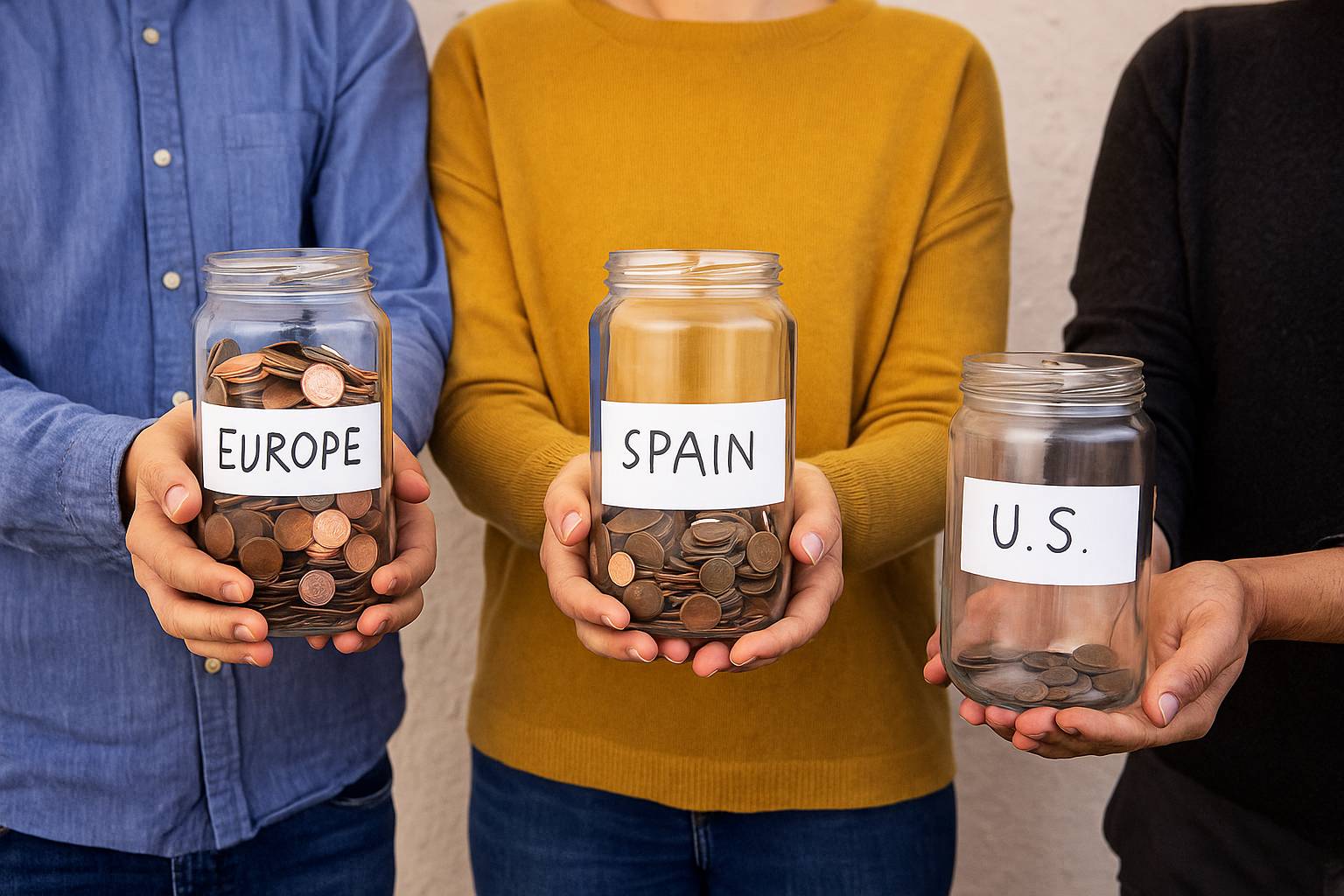
Across Europe, many families are holding on to more of their income than ever before. The Euro area saving rate is around 15%, higher than pre-pandemic levels. In Spain, the rate is even more remarkable — often staying in double digits as people prioritize security over risk. Meanwhile, in the U.S., savings have slipped back to about 4.6% of disposable income, according to the latest data from the Bureau of Economic Analysis.
So, what explains these differences? Let’s unpack what’s going on — and more importantly, what you can do to adapt your own saving strategy in 2025.
💶 Europe: Caution Meets Stability
Europeans, by nature, tend to be cautious savers — and 2025 is no exception.
After years of inflation and economic uncertainty, many households are focusing on financial resilience rather than growth. Think of it as Europe’s “safety-first” era.
Interest rates, which had been near zero for much of the 2010s, are now meaningfully higher. That means savers finally get rewarded — you can earn around 3–4% on short-term deposits or savings accounts in some European countries.
But there’s another reason Europeans are saving more: aging populations and shaky pension systems. People realize they can’t rely entirely on public pensions anymore, so they’re setting aside more on their own.
Example:
If a typical household in France used to save €300 a month before the pandemic, that number might now be €400–€500 — not necessarily because they earn more, but because they feel they need to.
In short: Europe saves because it’s cautious — and because it finally pays off again.
🇪🇸 Spain: Learning from the Past
Spain’s saving behavior tells a fascinating story.
After the financial crisis of 2008, many Spanish families became deeply aware of how fragile financial stability can be. The result? A cultural shift toward saving whenever possible.
By 2025, Spanish households are saving between 12% and 20% of their income, depending on the quarter — a rate much higher than before COVID-19.
There’s a mix of reasons:
- Memories of past crises. Many remember the housing bubble burst and the long recovery that followed.
- A more flexible job market. With more people working freelance or on short contracts, there’s a stronger need for personal buffers.
- Family-oriented culture. Spaniards often support children, parents, or extended family — so building savings isn’t just about personal comfort; it’s about protecting loved ones.
Example:
A self-employed designer in Madrid might aim to keep six months of living expenses — say €9,000 — in a high-interest savings account, just in case work slows down. That mindset is becoming the norm, not the exception.
The good news is that interest rates on savings accounts in Spain have improved. Online banks and neobanks often pay better than traditional ones — some offering up to 3.5% APY on savings.
Spain’s lesson for the world?
“Saving isn’t fear — it’s freedom.”
🇺🇸 United States: Spending Bounces Back
Across the Atlantic, Americans are showing a different pattern.
During the pandemic, saving rates shot up to record highs as people stayed home and received government support. But by 2025, that extra cushion has mostly vanished. The U.S. saving rate is now around 4.6%, roughly half of its long-term average.
Why?
- Rising costs of living — rent, groceries, and childcare have eaten into disposable income.
- Strong consumer spending culture. Americans tend to spend more on experiences and convenience.
- High household debt. Credit card balances are at record levels, making saving harder for many families.
That said, not all is bad news. U.S. households are still investing — through retirement accounts like 401(k)s, index funds, and ETFs. The mindset is: “I’ll invest for the future instead of hoarding cash.”
Example:
A family in Texas might keep a $5,000 emergency fund and direct the rest into an S&P 500 index fund every month. It’s a riskier approach, but it reflects an optimism that the market will reward long-term consistency.
The U.S. shows us that saving alone isn’t enough — you also need to put your money to work.
💡 The Common Thread: Purposeful Saving
Despite the regional differences, one theme connects everyone in 2025:
People are saving with purpose — not just for emergencies, but for flexibility.
Saving today is less about hoarding and more about buying options: the option to start a business, take time off, or handle life’s curveballs without panic.
I like to think of savings as a personal shock absorber. You can’t control every bump in the road, but with the right cushion, you won’t lose control of the car.
🧭 How to Build a Smarter Saving Strategy in 2025
If you’re wondering how to adapt your saving habits this year, here’s a simple roadmap that works anywhere — whether you’re in Madrid, Miami, or Manchester.
1. Start with a “Safety First” fund
This is your foundation — 3 to 6 months of essential expenses. Keep it in an easy-access, insured savings account.
💡 Example: If your monthly expenses are €1,200, aim for €3,600–€7,200 as your safety cushion.
2. Use “Savings Buckets”
Divide your money into goals:
- Now: everyday expenses
- Soon: next 1–3 years (trips, car, education)
- Later: long-term (retirement, investments)
This helps you avoid mixing short-term cash with long-term goals.
3. Automate your savings
Set up an automatic transfer every payday. It’s easier to “pay yourself first” than to rely on leftover money at month’s end.
4. Earn some interest — safely
Look for high-yield savings accounts or short-term government bonds. In Europe and Spain, online banks like ING, Revolut, or MyInvestor often offer competitive rates.
5. Gradually move from saving → investing
Once your safety net is ready, start investing small amounts monthly. Even €50–€100 can compound meaningfully over time.
🧠 Real-Life Example: The “Two-Account Trick”
Here’s a method I often recommend:
- Account #1: Living Account – where your salary arrives and bills get paid.
- Account #2: Future Fund – for saving and investing only.
Each payday, transfer a fixed percentage (say, 20%) from Account #1 to Account #2 automatically. That simple habit turns saving from a choice into a routine.
🌍 What You Can Learn from Each Region
- Europe: Stability pays — steady saving creates peace of mind.
- Spain: Family and foresight matter — protect what you love.
- U.S.: Don’t stop at saving — invest for growth once you’re ready.
🚀 Your Next Step
Ask yourself three simple questions:
- If I lost my income today, how long could I cover my essentials?
- Am I earning interest on my savings — or letting inflation eat them?
- Do I have a clear goal for each euro or dollar I save?
If any answer is “no,” that’s your homework this month.
Remember, saving isn’t just about numbers — it’s about confidence.
When you know you’re prepared, life feels lighter.
So, start where you are, use what you have, and build step by step.
Your future self will thank you.
Internal Links:
Saving in 2025 — Europe vs. Spain vs. U.S.
- Investing in 2025: The Barbell Is Back
- From Spain, With Goals: A 2025 Saving & Investing Plan You Can Actually Follow
Share this content:












Post Comment
You must be logged in to post a comment.