What the Economy Is All About
What the Economy Is All About: A Friendly Guide for Everyone
Me, OK, I’ve been thinking about the economy. The economy, is this one of those words that we hear all the time, right? “The economy is doing well,” or “Yeah, that economy is tough.” But if you stop and think. That’s something. It can feel weighty and intimidating at times. But the whole point is that we’re all involved–and it’s just what we do together to make, trade or use stuff we’ll need or want.
It’s why your coffee has a price, and how a town can afford to build a new school. Let’s simplify it into regular thoughts. I want you to walk away feeling like you can nod your head to the news, and maybe join the conversation.
What is the Economy, Really?
Strip off the jargon and image this: A large, buzzing network. It’s made up of you and me, the things we have (like materials and skills) and everything we make or do—from a loaf of bread to a haircut to a smartphone app. It’s about how we change time and things into useful things, and how those utilities get to the people who need them. At root, the economy is merely the narrative of how we support ourselves and one another.
Why Should You Care?
For it’s not some abstract principle. It’s a part of the very fabric of your life:
Your job and paycheck: Is hiring booming, or are companies tightening?
Your grocery bill: Why does milk cost more this year?
Your community: Can we fix these roads? Fund that library?
Real people live with that weight.
Production: That is the production part of it. Making things and services with resources (land, labor, tools, ideas). How does that bakery make so many bagels?
Exchange/Trade: Here is part for trade. Markets, prices, money—they just get you what you made and let you do the work — to someone who loves it, whatever they are, across town or across the ocean.
Consumption: The use/leveraging part. That is you and I are choosing what we buy, what we save for, what we are really interested with in life.
Distribution: This is where the who or what gets what. What is the division of rewards between workers, owners and investors? Because that is a matter of fairness and efficiency.
Government & Policy: This is for rule-making. Taxes and spending, interest rates, and regulations — these are the guardrails and levers that would keep things pretty stable and fair.
Growth & Cycles: An economy has a rhythm, almost like breathing. There are times of growth and energy—boom times when opportunities feel wide open.
Now, let’s interpret the news headlines:
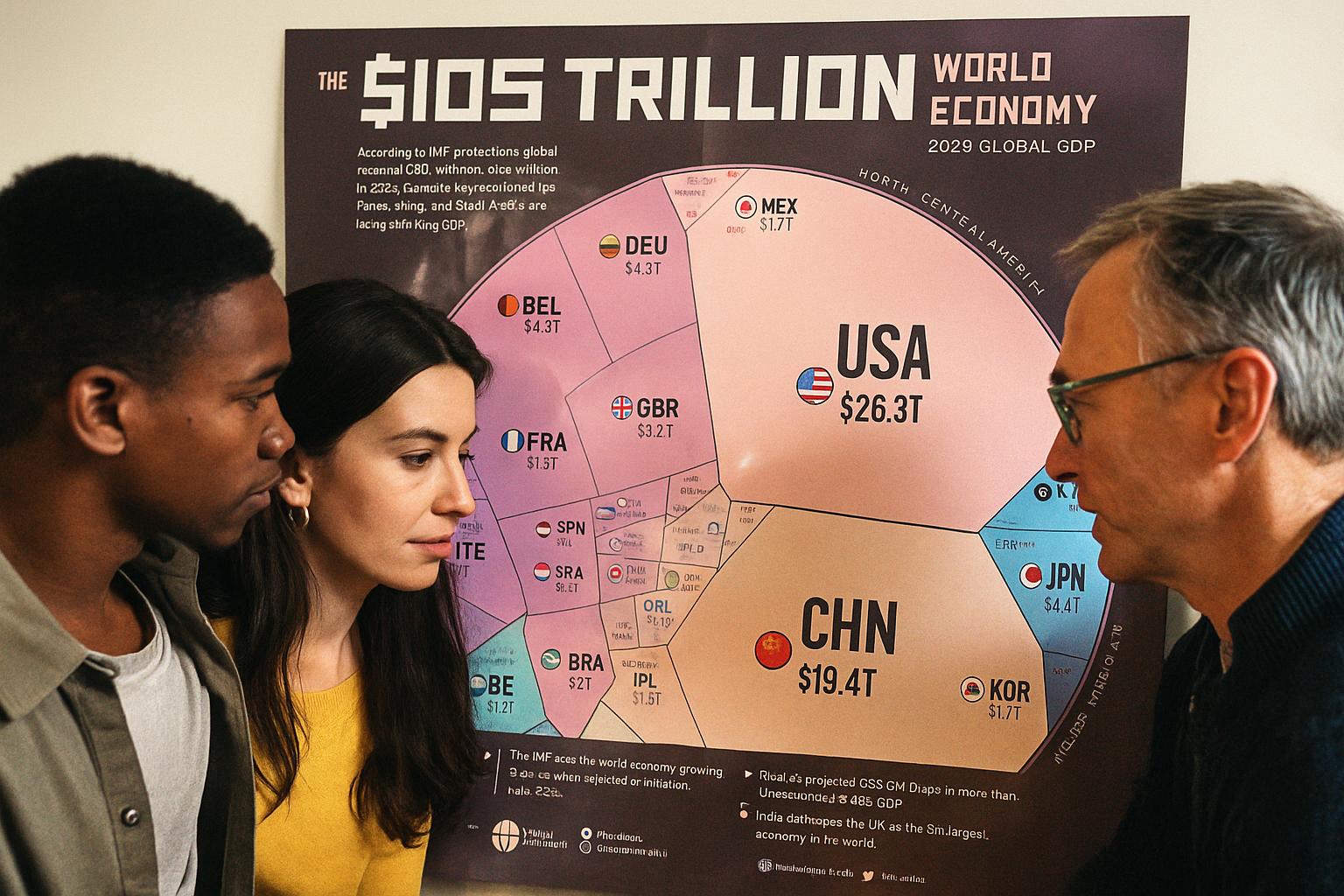
GDP: The economy’s overall “output.” Sort of like the size of the pie.
Inflation: When price increases for everyday things increase, so your dollar does not stretch as far.
The Unemployment Rate: That percentage is more than a statistic. It’s for every person polishing their resume, hitting “submit” over and over, and facing the quiet anxiety of a silent phone. It’s the story of someone wanting to contribute but being left on the sidelines.
Interest Rates: This is simply the “price tag” on borrowing money. When rates are high, that tag is steep—making everything from a car loan to a business dream more expensive to finance.
How It Plays Out in Your wallet. This is where it gets personal.
The economy influences:
Getting that raise or facing a layoff.
The monthly bill for your car loan or mortgage.
Your savings or retirement fund returns.
Why a new video game console is suddenly hard to find or crazy expensive.
The Big Forces at Play Today.
A few things are changing from here on out:
Globalization: A factory closing overseas can drive up the price at your nearest brick-and-mortar store all over the country.
Tech & AI: Work looks different now with new jobs and the loss of employment possibilities.
Demographics: An aging population changes both what we need and who’s working.
Climate Change: Getting us to rethink how we produce and consume—the “green economy.”
Inequality: An emerging discussion about the divide between the rich and everybody else.
Why Economists Disagree. People see things differently – a.E! Some believe markets will figure themselves out on their own. Others believe governments must intervene actively — but particularly during crises. They deal with human psychology (we’re not always rational!). These diverse theories are just different tools for making sense of a wildly complex system.
How to Think Like an Economist (And How to Help Yourself!) Some of the core ideas don’t require a degree to implement, including:
Scarcity & Choice: We have time, money, and resource limitations. Every decision is tantamount to losing something else.
Opportunity Cost: That “thing besides” you gave up is the true cost of your choice. And it’s in our everyday choices, too. Choosing to spend $50 on a dinner out is also a choice not to save or invest that same $50 for tomorrow. Our daily decisions are tiny economic engines.
Incentives Matter, Deeply. It is human nature.
Trade-offs Are Almost Everywhere: There is never a ‘perfect’ solution but only a range of good choices, each one with its own set of pros and cons.
A Few Things We Commonly Get It Right.
“The economy = the stock market.” Not quite. The stock market is part of the economy, but the economy is just the puzzle, jobs that you rely on for production, factories that are often just startup companies and your local store.
“Rising GDP means everyone is better off.” It can hide inequality. If the pie expands, but only an elite few people receive larger slices, and no one else does, the growth will not be felt.
“Inflation is always the enemy.” Low, stable inflation can mean a healthy economy continuing to grow. It is runaway inflation or deflation of the lower type (falling prices) that causes big problems.
Conclusion: Why This Matters to You. Knowing this stuff gives you strength. It links the dots between a headline and your life. That helps you make better decisions with your money, your career and your vote. It converts a mysterious and intimidating force into a system of human decisions — something we can all discuss, understand and construct.
Final Thought.
So when you strip it all back, the economy isn’t really about charts and graphs. It’s about us. But at its heart, it’s deeply, beautifully human.
Share this content:



Post Comment
You must be logged in to post a comment.