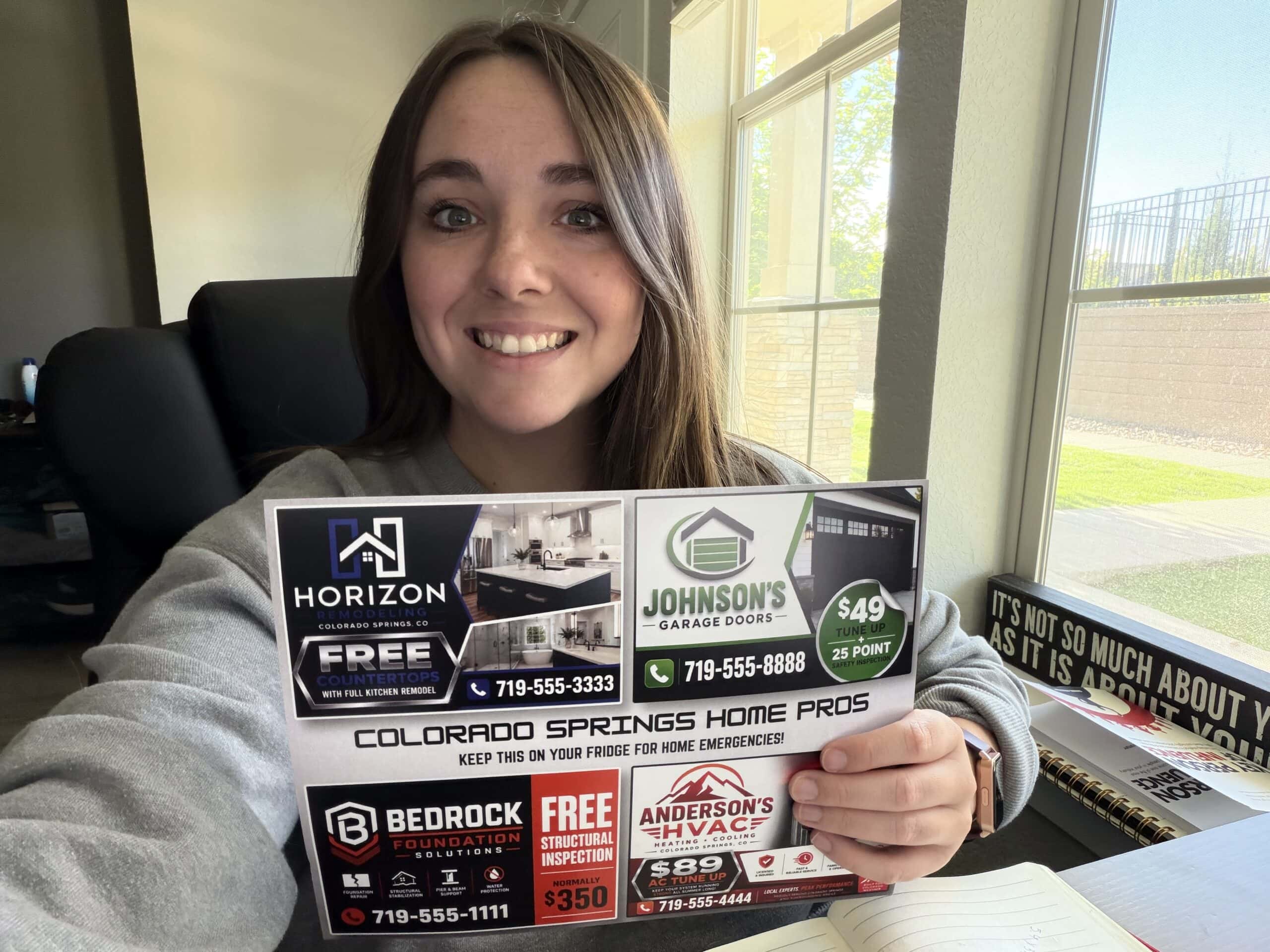

How a Community Direct Mail Side Hustle Works
A community direct mail card is an oversized postcard, typically 6.5 by 12 inches, that features multiple local businesses on one mailer. Instead of a single business paying to design, print, and mail its own card, several businesses share the cost. Each business purchases an ad spot, the card is printed and sent to thousands of homes in a chosen neighborhood, and the organizer keeps the difference between the total collected from advertisers and the printing/postage expenses.
Revenue Potential
According to Rachel and Dalton, who have run this business for several years, one card can generate between $1,100 and $3,500 in profit. Their range is based on charging $150 to $300 per ad spot for 16 spaces per card. After printing and postage for a mailing to about 2,500 homes, the profit falls roughly within that interval. They have reported over $100,000 in total revenue from more than 40 mailings.
Getting Started With Little or No Upfront Cost
The model requires virtually no money out of pocket to begin. Advertisers pay for their spots before any printing is ordered. The organizer collects payment, then uses those funds to cover printing and postage through a printer that offers full Every Door Direct Mail (EDDM) fulfillment. Design can be done with free tools such as Canva; paid versions or AI tools like ChatGPT are optional enhancements.
Finding Advertisers
Outreach is primarily conducted via Facebook Messenger and email. A simple, friendly message works best: “We’re putting together a postcard featuring local businesses that goes to 2,500 homes in [neighborhood]. We only allow one business per industry. Would you be interested?” Target businesses that already understand advertising and sell higher‑ticket services—HVAC, plumbing, roofing, landscaping, realtors, med spas, dentists, and auto repair—because the cost of a spot is a small fraction of their typical job value. Businesses that are already advertising elsewhere (e.g., Facebook ads, billboards) tend to respond quickly.
Why Businesses Choose the Shared Card
Mailing 2,500 postcards independently would cost a business north of $2,000 once design, printing, and postage are added. Being on a shared card reduces that expense to a couple hundred dollars while reaching the same mailboxes. Compared with crowded and costly online ads, the oversized card stands out in a mailbox where households now receive only about two pieces of mail per day, increasing the likelihood it will be seen and retained.
Selecting the Mailing Area With USPS EDDM
Neighborhoods are chosen using the USPS Every Door Direct Mail mapping tool. After entering a ZIP code or address, the tool displays carrier routes, the number of homes on each route, and demographic data such as average household income, age, and household size. The ideal audience falls in the $70,000‑$120,000 household income range—middle to upper‑middle‑class homeowners who are likely to hire local services and appreciate a good deal. Routes are selected until roughly 2,500 residential addresses are reached.
Printing and Fulfillment Process
Organizers do not need to handle printing or postal logistics themselves. By selecting a printer that advertises “full fulfillment EDDM” or “EDDM full service,” the printer takes care of:
- Printing the cards at the correct size (6.5×12 inches)
- Adding the required postage marking instead of a stamp
- Bundling the cards according to USPS specifications
- Completing and submitting the necessary paperwork
- Delivering the bundled cards to the appropriate post office for delivery
The organizer only needs to provide the final design file and the list of carrier routes selected via the EDDM tool.
Timeline From Concept to Mailbox
For a first card, expect four to six weeks from the initial outreach to delivery. Most of that time is spent selling ad spots. Once a few advertisers renew and word spreads, filling a card can drop to one or two weeks. After the sixteenth spot is sold and approved, the design is sent to the printer; cards typically appear in mailboxes two to three weeks later.
Step‑by‑Step Launch Guide
- Choose a neighborhood using the USPS EDDM mapping tool, aiming for about 2,500 homes with average household income between $70,000 and $120,000.
- Obtain a quote from a printer that offers full EDDM fulfillment for a 6.5×12 inch postcard mailed to your selected routes; this reveals your cost per card.
- Set your price per ad spot: divide the total printing/postage cost by 16 and add the desired profit per spot (most areas land between $150 and $300).
- Create a simple card template in Canva with eight ad spaces on the front and eight on the back.
- Build a list of ~100 local businesses across different industries, prioritizing higher‑ticket services.
- Begin daily outreach—send 10 to 15 personalized messages via Facebook or email using the script above; reply to all responses and move interested parties to a quick phone call.
- When a business agrees, send a payment link immediately; a spot is considered sold only after payment is received.
- Collect each advertiser’s logo, phone number, and the offer they want displayed, then create their ad in Canva (or with AI assistance) and place it into the card layout.
- Once all 16 spots are paid and approved, send the final design file and the EDDM route list to the printer; they handle printing, bundling, paperwork, and delivery to the post office.
- After the cards are mailed, follow up with each advertiser to see if they’d like to renew for the next mailing, then start the process for the next neighborhood.
Community Card Playbook Membership
Rachel and Dalton created the Community Card Playbook membership to teach the exact system they use. It includes printer recommendations, outreach scripts, card templates, video walkthroughs, step‑by‑step trainings on using the EDDM tool, setting up automated email, and live weekly Q&A sessions. The goal of the membership is to help members get their first card in the mail; after that initial success, the process becomes repeatable.